Written and Directed by Charles Chaplin
Music by Charles Chaplin
Cinematography Roland Totheroh
Starring Charles Chaplin and Paulette Goddard

Charlie Chaplin's depression-era masterpiece Modern Times was to represent a significant change in the icon's body of work from this point on. Not only was it his last silent picture (not entirely silent, though, for reasons which we will come to later) and the last vehicle for his character of the Tramp (though a variation of the character could be seen in The Great Dictator), but every subsequent film of his- with the possible exception of Limelight -would have overt political backdrops.
 With his overnight rise to international stardom in the late 1910s and subsequent entry into artistic and political circles, Chaplin began to become increasingly politically aware, and it was inevitable that his "political awakening" would be reflected in his work. His interest in world events led the actor-filmmaker to seek meetings with Mahatma Gandhi and Winston Churchill among many others. Gandhi and his views on industrialisation especially seemed to have made a strong impression on him. But it was not simply the perils of industrialised labour that the film would come to address. The devastation caused by the Great Depression of the 30s, which he witnessed on his trip and back in America, would also find their way into the film.
Despite its grim premise, Modern Times is actually a light-hearted take on the social realities of the time. While general reviews of the time could see nothing beyond the humour, other critics were miffed with the film's refusal to talk when the world was held in sway by talking pictures, its eschewing of plot, and its simple visual style, which seemed dated to many. More highbrow critics disdained its political ambiguity.
There is no doubt that the film does veer in tone- the futuristic vision in the initial factory sequences giving way to a more contemporary milieu in the rest of the film, Modern Times is rather uneven in tone. But the brilliance of these sequences more than compensates for this minor flaw.

The opening montage- A shot of a herd of sheep dissolving into one of factory workers and a shot of a large factory, is very evident of Chaplin's political leanings. What follows is a series of sketches that begin with the Tramp tightening nuts in a factory that manufactures God-knows-what, until he himself goes nuts over the increasing demands thrust upon him and other workers. Joined by a gamine (Paulette Goddard, his third wife), they fight it out against a world that is becoming increasingly mechanised and profit-driven, to assert their individuality. While they find little success, they are determined to keep fighting.
As with most of Chaplin's work, the things that stick to your mind are the set-pieces- the Tramp being used as guinea pig on a feeding machine that feeds the workers while at work so that the lunch hour could be eliminated, the home that the Tramp and Gamine dream up for themselves, the ballet on roller skates, the Tramp's routines as waiter and so on. While most of the gags aren't fresh in themselves (He does refine some of his old routines from the shorts made for Mutual two decades earlier), he improves upon them, incorporating his own physical dexterity and improved sense of timing, that they blend seamlessly into the narrative.
The characterisation in Modern Times is worth a mention. Apart from the tramp and the gamine, very few characters have any significant screen time. Even the credits mention only two characters, that of the Tramp and the Gamine, the others simply mentioned as supporting players. Their significance is reduced to that of any other prop, simply entering and leaving after their role in the story is finished. Could this be a hint that the world is increasingly peopled by automatons?
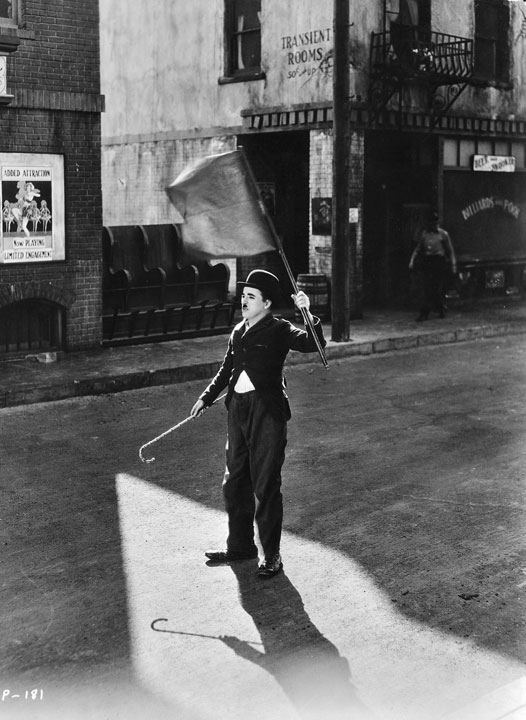
 While the opening montage was enough to brand Chaplin as a leftist in an America that treats any leftwing tendency with utmost derision, another sequence that makes a more explicit reference to communist paranoia in the States would forever brand him as a Red in the eyes of Americans. This, perhaps one of the most brilliantly executed set pieces in the film, shows Charlie picking up a red flag dropped from a truck and walking towards it, only to be nabbed by the police who suspect him to be a communist leader. Using no words, and in no more than five shots, Chaplin succeeds in driving home the message. Watching this sequence, one wonders what the pundits who brushed aside Chaplin as "uncinematic", were actually thinking of.
Another remarkable facet of the film is its sophisticated use of sound. True, Chaplin was averse to talk, but he was not averse to the possibilities that sound offered the filmmaker. In his previous release, City Lights, he took the plunge into the sound film by composing a score and adding a few sound effects. But he took his experiments even further here. The only "sounds" you hear in Modern Times are the sounds of machines, of objects. The human voice is otherwise silenced, heard only through a machine like a television screen, radio, or a record. The only person who finds his voice in the film is the Tramp, who breaks into song towards the end, but which is of no particular language, for he is bereft of linguistic barriers. One particular sequence, involving the Tramp and a woman having a cup of tea, is particularly notable, anticipating the work of Jacques Tati.
Modern Times would find more acceptance in the post-WW2 era, and its influence could be seen in works like George Orwell's 1984, with its Big Brother and telescreen clearly reminding us of Chaplin's film. While the film could be considered Chaplin's most formally inventive work, it endures because of the way it resonates with our own times.

Music by Charles Chaplin
Cinematography Roland Totheroh
Starring Charles Chaplin and Paulette Goddard
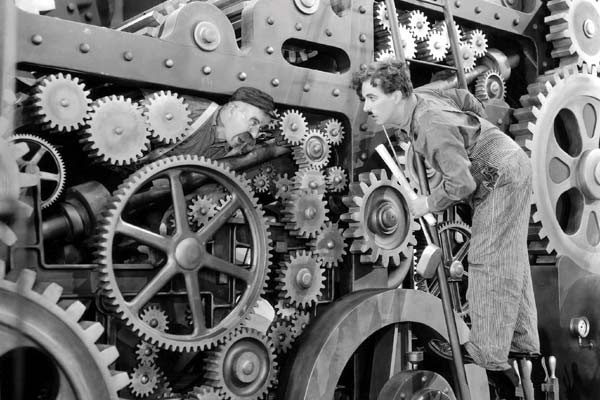
Charlie Chaplin's depression-era masterpiece Modern Times was to represent a significant change in the icon's body of work from this point on. Not only was it his last silent picture (not entirely silent, though, for reasons which we will come to later) and the last vehicle for his character of the Tramp (though a variation of the character could be seen in The Great Dictator), but every subsequent film of his- with the possible exception of Limelight -would have overt political backdrops.

Despite its grim premise, Modern Times is actually a light-hearted take on the social realities of the time. While general reviews of the time could see nothing beyond the humour, other critics were miffed with the film's refusal to talk when the world was held in sway by talking pictures, its eschewing of plot, and its simple visual style, which seemed dated to many. More highbrow critics disdained its political ambiguity.
There is no doubt that the film does veer in tone- the futuristic vision in the initial factory sequences giving way to a more contemporary milieu in the rest of the film, Modern Times is rather uneven in tone. But the brilliance of these sequences more than compensates for this minor flaw.
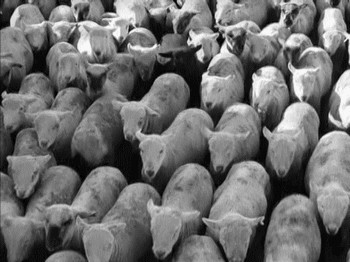
The opening montage- A shot of a herd of sheep dissolving into one of factory workers and a shot of a large factory, is very evident of Chaplin's political leanings. What follows is a series of sketches that begin with the Tramp tightening nuts in a factory that manufactures God-knows-what, until he himself goes nuts over the increasing demands thrust upon him and other workers. Joined by a gamine (Paulette Goddard, his third wife), they fight it out against a world that is becoming increasingly mechanised and profit-driven, to assert their individuality. While they find little success, they are determined to keep fighting.
As with most of Chaplin's work, the things that stick to your mind are the set-pieces- the Tramp being used as guinea pig on a feeding machine that feeds the workers while at work so that the lunch hour could be eliminated, the home that the Tramp and Gamine dream up for themselves, the ballet on roller skates, the Tramp's routines as waiter and so on. While most of the gags aren't fresh in themselves (He does refine some of his old routines from the shorts made for Mutual two decades earlier), he improves upon them, incorporating his own physical dexterity and improved sense of timing, that they blend seamlessly into the narrative.
The characterisation in Modern Times is worth a mention. Apart from the tramp and the gamine, very few characters have any significant screen time. Even the credits mention only two characters, that of the Tramp and the Gamine, the others simply mentioned as supporting players. Their significance is reduced to that of any other prop, simply entering and leaving after their role in the story is finished. Could this be a hint that the world is increasingly peopled by automatons?
Another remarkable facet of the film is its sophisticated use of sound. True, Chaplin was averse to talk, but he was not averse to the possibilities that sound offered the filmmaker. In his previous release, City Lights, he took the plunge into the sound film by composing a score and adding a few sound effects. But he took his experiments even further here. The only "sounds" you hear in Modern Times are the sounds of machines, of objects. The human voice is otherwise silenced, heard only through a machine like a television screen, radio, or a record. The only person who finds his voice in the film is the Tramp, who breaks into song towards the end, but which is of no particular language, for he is bereft of linguistic barriers. One particular sequence, involving the Tramp and a woman having a cup of tea, is particularly notable, anticipating the work of Jacques Tati.
Modern Times would find more acceptance in the post-WW2 era, and its influence could be seen in works like George Orwell's 1984, with its Big Brother and telescreen clearly reminding us of Chaplin's film. While the film could be considered Chaplin's most formally inventive work, it endures because of the way it resonates with our own times.