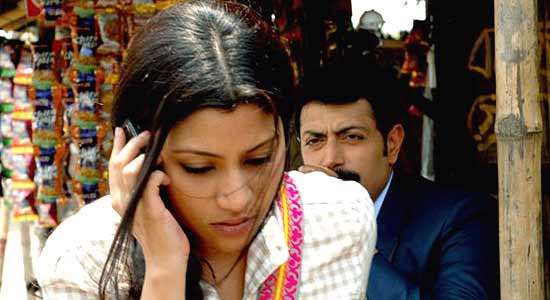
For all the controversies that marred the Adoor Gopalakrishnan Committee, delegates at this year's edition of the International Film Festival of Kerala were almost unanimous in their appreciation for the package presented this year. This time around, I had a lot more time in my hands, and feasted my eyes on more than a dozen movies, including some featured in the competition. So I do have a lot to write about, though I won't be writing about all of them; just the ones that made the best impression on me.
 |
| They are the dogs |
Of the films I saw in the competition section, the one that impressed me the most was They are the Dogs, a Moroccan-French co-production written and directed by Hicham Lasri. Set in 2011 during the Arab Spring in Casablanca, the film revolves around a TV news reporter and his crew who stumble upon an old man out of prison after he was arrested in the 1981 Casablanca uprising. Thirty years on, the man has slightly lost his mental balance, can't remember his name (he identifies himself with the number 404), and wants to reunite with his wife and son. The reporter, who smells a good story, follows him along with his crew.
With much humour and irony, They are the Dogs, through the senile old man (played admirably by Hassan Badida), reflects on the harsh political conditions in Morocco, and we see the film as recorded by the TV news camera. The almost cinéma vérité approach makes the camera a participant in the narrative, and the object of people's ire as an unwanted intrusion; even the news reporter and his crew are subject to the same treatment. But the comically exaggerated reactions of people towards the camera brings home the truth that what we are watching is no documentary. By employing the cinema verite aesthetic to craft a work of conscious artifice, director Lasri subverts its very purpose.
Seven-year-old Matias (Sebastian Molinaro) and his pregnant mother Laura (Julieta Diaz) flee his abusive father in search of a safer abode in the Argentinian Refugiado, winner of the best film award. The Diego Lerman-directed drama follows the mother-son duo as they move from women's shelter to hotel and a brothel before finally arriving at Laura's childhood home, where her mother stays. Her husband, Fabian, is never seen in the film, but he remains a constant presence through his relentless phone calls.
 |
| Refugiado |
Director Lerman presents the story as little Matias sees it, and it is mostly through his point of view that the story develops, giving several sequences a childlike naivete. Especially memorable is the
episode where Matias befriends another little girl about his age in the
women's shelter until he has to leave with his mother. But there are moments when the film shifts to Laura's point of view, especially when Matias locks himself up in the bathroom demanding that he take all his toys as they prepare to desert their home, with Fabian close on their heels. The film features gripping performances from the lead pair of mother and son, along with impressive cinematography by Wojciech Staron, and the final sequence of the boy running into the woods somehow seemed to remind me of Truffaut's 400 Blows.
Less impressed I was with the Japanese Summer, Kyoto, which won Hiroshi Toda the best direction prize. In it, an aging couple make their living by selling scented bags, until one evening the husband brings home a man he had found lying unconscious outside. The next morning, the stranger, feeling better, expresses his gratitude by offering to deliver the day's consignment of scented bags. But when he fails to turn up with the money after dusk, the couple grow anxious. If the film's theme seemed like a pretentious parable, its stylistics smacked of Ozu to me.
 |
| Hill of Freedom |
Another film I found remarkable was Hill of Freedom by the South Korean director Hong Sang-soo, a romantic comedy featured in the World Cinema section. Kwon (Seo Young-hwa), a teacher at a language school in Seoul, receives a bunch of letters Mori (Ryo Kase),
a Japanese teacher whose proposal she had rejected and who had come
over to the capital city to meet her during her absence, and written a
string of letters to her. The letters being undated and mixed up after
they were dropped by Kwon, give us an account of Mori's stay in Seoul in
non-chronological order, in the order in which Kwon reads them, and we
come across such characters as Sangwon
(Kim Eui-sung), his landlady's nephew, and Youngsun (Moon Sori), who
runs a cafe that bears the film's title, and with whom Mori develops a
relationship.
Being
a cross-culture film, it seems only natural that most of the dialogues
are in English. The director uses the opportunity to poke gentle fun at
the superficial internationalism of present-day urban youth, which is in
large part derived from American popular culture. Especially amusing
are the conversations in English, which seldom go beyond fake
pleasantries and the most banal of exchanges. While the fragmented
narrative and single-take coverage of scenes are innovations that are as
old as cinema itself, director Hong-sang Soo's cleverly written script
gives the film its originality, backed by a brilliantly deadpan
performance from lead actor Ryo Kase, who played the menacing boyfriend in Kiarostami's Like Someone in Love, which I had seen and written about two years back here.
 |
| Miklos Jancso |
However, my discovery of 2014 was the Hungarian director Miklos Jancso, whose work was presented in a retrospective here. Having only read about the master, who died earlier this year, in film writings, I knew what to expect.
Paying not the slightest obeisance to the rules of narrative cinema, Jancso's films, often dealing with Hungarian history and politics, take the form of highly stylised ballets and are filmed in takes that go on for minutes without a cut, employing complex camera movements. In total, a Jancso feature, which could have a running time of anywhere between 70-90 minutes, may not have more than 30 shots.
While I could not read into the
elaborately choreographed ballets (given my ignorance of Hungarian history or her politics or ballet dancing), the qualities that struck me
were his style. I had known and admired the work of several long-take masters like Renoir, Mizoguchi, and Welles, but Jancso's use of the long take seemed strikingly original.
I managed to catch Silence and Cry (1968) and Red Psalm (1971) in decent, occasionally scratchy, 35mm prints. The former film told the story of a revolutionary who goes into hiding in the country after the failed Hungarian uprising of 1919. While the film was a more straightforward narrative with no ballets or songs, it did feature his long takes. Red Psalm, on the other hand, dealt with a peasant uprising in 1890, featured the very qualities of Jancso's work mentioned above, and won the best direction prize at the 1972 Cannes Film Festival. While the print of Red Psalm, shot in colour, had faded to pink, Silence and Cry, in black-and-white, were beautiful in the portions without scratches, more beautiful than any digital projection could dream of.
 |
| Buster Keaton |
The other rewarding experience at this festival was the opportunity to watch Buster Keaton, also in retrospective. Though I had seen the great silent comedian's work on laptop and on TV, nothing really compares to the experience of watching silent comedy on a 25ft screen, in the dimensions they were originally designed to be seen. I couldn't watch The General (1927), arguably his greatest film, which was screened before I could make it there, though I would have given anything (except my job) to watch it on the big screen. But I did manage to catch the marvellous Sherlock Jr. (1924). While the celebrated sequence where Buster, working as movie projectionist, enters the movie screen remains its biggest eye-grabber, the other gags from the film were no less astounding, and was the film greeted with applause that could match that of any film presented this year. Not bad, for a film made nine decades earlier.
Seven Chances (1925), however, was a disappointment, not merely for its unremarkable plot, but more for its blatant racism towards African-Americans, and the gags directed at them seemed to me in poor taste, and especially unfortunate for an artist like Keaton. But this retrospective has had me looking forward to more opportunities to catch silent cinema, especially silent comedy, projected on a 25ft screen.
I ended my brief (but longer than usual) stay at this year's festival with Mohsen Makhmalbaf's President, made in Georgia. The Iranian director-in-exile, much affected by the Arab Spring and other uprisings against dictatorships, resorts to a political parable here, as a dictator of an unnamed country witnesses an revolution that topples his government. Generally referred to as President and addressed as Your Majesty by his grandson, the military also turns against him, forcing him and his grandson try to flee in disguise to the neighbouring country, where the rest of his family are. What begins as a lightly comic take gradually transforms into high-octane drama, as in their attempts to conceal their true identities, the dethroned ruler and his grandson find themselves witnesses to the suffering inflicted by his brutal regime, and the widespread turmoil that revolution has caused.
 |
| President |
While it is a given that dictatorships are ruthless and uprisings were only to be expected, Makhmalbaf refuses to side with any group. While he lampoons the vanity of the dictator and his family, he is seldom demonised. While the suffering he inflicted on his subjects prior to the revolution is often referred to, Makhmalbaf reminds us of the general state of anarchy and opportunism that accompanies an uprising, and often questions the legitimacy of violent revolution. Towards the end, Makhmalbaf turns his camera away from what would seem like the film's tragic outcome to a shot of the dictator's grandson, as he erupts into a dance for democracy.
While the film risks seeming simplistic in its attempts to be universal, I still find it one of the most compelling films I've seen in a long time. Makhmalbaf narrates his story with such ease without the slightest self-conscious attempt at cinematic bravura, and the transition in tone from the comic to the dramatic so seamless, that you realise you are watching the work of one of the finest directors today.
So that's that for now. See you until my next post.
My stint at this year's edition of the
International Film Festival of Kerala happened to be shorter than
last year's, lasting hardly two days. So, I could watch no
more than five films, and none of them were in the competition
section. Nevertheless I am going to chart down what I thought of the
films I saw below, since I don't want to keep my readers waiting for
my next entry (what pomposity!).
At least, I was lucky enough to watch ATouch of Sin, one of the year's
most acclaimed films by the Chinese Jia Zhang-ke. Far from the rosy
portrayal of contemporary China that we are used to hearing in the media, the film is built together out of four separate stories,
none of which have separate titles or common characters but a common
theme: helpless individuals caught in an increasingly corrupt,
materialist and profit-driven world, driven to commit acts of
violence, against others and oneself. The pace of the film is, for
the large part, contemplative in tempo, with sudden outbursts of
violence. Cinematographer Pawel Edelman captures the Chinese
landscape in all its serenity, starkly contrasting it with the bleak lives of the
characters in the four stories.
Later,
I caught up with Claire Denis' 2001 film Trouble Every Day,
a multilingual erotic horror film that is centred on two parallel
stories, one of an American couple and the other of a French couple,
both in Paris. While the American husband is impotent, the French
wife's sexual appetite is so insatiable that she engages in sexual
encounters with various men, and ends up drinking their very
blood. That is all the plot there is to this film.
In what seems to
me to be a surreal exploration of the discrepancies between male and
female sexuality, Trouble Every Day has
more than its fair share of gore, including an extended lovemaking
scene that ends in cannibalism.
The Mozambican film Virgin Margarida by Licinio Azevedo charts the experiences of sex workers in guerrilla camps in post-colonial Mozambique in the 1970s, into which a teenager Margarida (Iva Mugalela), mistaken for one them, is forcibly deported. Under the leadership of a woman guerrilla who is single-minded in her devotion to 'cleanse' them of their colonial mindset and make 'new women' out of them, the women, along with Margarida, undergo harsh training sessions with harsh punishments for dissenters.

While director Azevedo definitely has got his heart in the right place in wanting to show how the revolution could bring about little change in the lives of ordinary citizens of the country and his script mixes irony and drama with relative ease, his performers, however, are unimpressive, chiefly because they fail to make the transition from the comic to the dramatic in their performance. But there is no denying that the film feels quite like one of our day and time, not of a distant period.
Perhaps the best film I got to see at this festival was The Crucified Lovers (1954), one of Kenji Mizoguchi's late masterpieces, in a 35mm print that had good contrast, despite the infrequent scratches. I had never seen Mizoguchi on the big screen, so I did not let go of the opportunity. As always, his indictment of Japanese patriarchy and hypocrisy is at his scathing best in this tale of a samurai's wife who is accused of adultery with one of her manservants, while her husband himself has a sexual interest in her maid.
Like his other masterpieces, The Crucified Lovers is testimony to Mizoguchi's genius as a visual stylist, especially in his trademark long takes, letting the action unfold in distanced views using a moving camera. Watching it on the big screen, I was once again convinced that he is, no doubt, one of the great masters of world cinema.

My last film at the festival, Act Zero by Gautam Ghose was the only Indian film I could see on this trip, one that tries to encapsulate in two hours and ten acts the various issues that haunt the country. While the basic premise is that of the CEO of a Multinational trying to invade the lands of tribals by deporting them and mining the area for bauxite, resulting in tensions between the tribal community and the CEO, the director crams in issues like Maoist insurgency, communalism, and throws in a fictional Binayak Sen. The result is an ineptly shot, preachy and didactic film, but one that is nevertheless watchable, thanks largely to the performances of Konkona Sen Sharma and Soumitra Chatterjee.
Thus ended my all-too-brief stay at the festival. There were several other films which I would want to have seen, especially the Jean Renoir retrospective, which screened such titles as Toni and La Bete Humaine, and a special section on German Expressionist cinema, which included such 20s classics as The Cabinet of Dr.Caligari and A Throw of Dice, which is set in India. But there's always another chance.