Come May 3, 2013 and India's film industry will be celebrating the hundredth year of its birth, for it was on this day exactly a hundred years ago that Raja Harishchandra, supposedly the first Indian film made by the first Indian filmmaker Dadasaheb Phalke, hit theatre screens. In a country known for its lackluster approach to film preservation (bar the efforts of PK Nair, founder of the National Film Archive of India, on whom a documentary, Celluloid Man was recently made, which I have written about here), the fact that we have got the date on which the film was released right is indeed remarkable. But is Raja Harishchandra really India's first film?

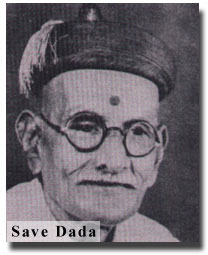
A little more probing would reveal that there have been films made in the country before Phalke's feature debut. Shortly after the Lumiere brothers screened their "actualities" in Bombay (As Mumbai was officially called then) in the late 1890s, a certain Harishchandra Sakharam Bhatwadekar, or Save Dada, a portrait photographer, made a series of factual films a la the Lumiere Brothers in India, the first of which was a wrestling match between two well known wrestlers of the time, in 1899. He even filmed perhaps India's first newsreel, the arrival of RP Paranjpe, a successful mathematician, from Cambridge in 1901.
In fact, the non-fiction cinema seemed to have been active in India well before Phalke made his entry. By the first decade of the 20th century, cinemas were already established in major cities of the country like Calcutta, Madras and Bombay (though it could be assumed that these theatres screened largely foreign films, like those of George Melies and Edwin Porter). Very soon, Bhatwadekar was joined by other names like Narayan G Devare, the Patnakar brothers and Hiralal Sen, who made factual films that documented day-to-day life in India. A company dedicated to filming newsreels, the Calcutta Film Gazette, was also started during this period.
Despite these facts, the credit for making the first Indian film has always gone to Dundiraj Govind Phalke, partly because none of the films before Raja Harishchandra have survived and also because of the fact that the documentary, or non-fiction film has never been taken seriously in India. But such a claim would be tantamount to assuming that the father of film would be George Melies and not the Lumiere Brothers or Edison.
What makes this celebration even more interesting is the fact that most histories of Indian cinema do recognise the earlier pioneers but since Harishchandra was the first full length motion picture made entirely by an Indian crew, at a full six reels (of which only two have survived) the film and its maker have been accorded first Indian film and first Indian filmmaker respectively. Nowhere do you find a voice that challenges this assumption.
Well, yes, there has been a challenge to this assumption, but of a wholly different kind. The argument that generally goes around is that it is not with Phalke's Harishchandra, but with Satyajit Ray's Pather Panchali that Indian cinema really begins. Mrinal Sen has been the most vocal about this stance. Though there is no doubting the greatness of Pather Panchali and the fact that it paved the path for a more personal cinema in India, such a claim only amounts to elitism. Yet it could generally be accepted that few filmmakers in India before Ray approached cinema in a wholly original way without the trappings of the theatre or literature. But it does not call for overlooking the achievements of the earlier filmmakers.
So will this piece initiate any debates on the real beginnings of Indian cinema? Very unlikely. Meanwhile, the celebration of our cinema's hundredth anniversary will be celebrated with full pomp and the glorious "achievements" of mostly Bollywood cinema will be glorified as part of the celebrations.
Directed by Ben Affleck
Written by Chris Terio
Starring Ben Affleck, Bryan Cranston, John Goodman, Alan Arkin
The moment I heard about the movie and its plot, I had a slight suspicion about what I thought the movie would be about. When the film won the Oscar for the best motion picture (announced by the first lady Michelle Obama at that), my suspicions were almost confirmed, and when I caught the movie at a local theater, I was convinced not only that I was right, but also the Academy of Motion Picture Arts and Sciences recognises films that seek to establish the political superiority of the USA, or "whites" in general.
How else would you describe an Oscar winning film that is so conventional that it is hardly distinguishable from a normal Hollywood release? Every dramatic device in the film has been incorporated at the most predictable moments, and there is hardly any mark of individuality to been in the movie, which can be seen from its visual and sound design. The tight camerawork, rapid cutting combined with the occasional one-liner makes for a tedious movie experience.
The film actually is inspired by true events, when the American embassy in Tehran was boycotted by Iranian revolutionaries during the Iranian hostage crisis of the late 1970s, and around 50 Americans were taken hostage, of which six escape into the Canadian Embassy. To rescue the six Americans, CIA exfiltration specialist Tony Mendez (Affleck) hatches up a plot where he travels to Iran as producer of a fake movie "Argo" to scout locations for the film. He travels to the country not only with false documents about a movie that is never going to be made but also with false identities for the six Americans who are currently in hiding.
The propaganda in the film is so blatant in its portrayal of Iranians as people driven wild by fanaticism, who try to resist violently the "sophistication" that America has to bring to them (as if the lynching of blacks in their own country were not driven by fanaticism). So as to prove that its claims are true, documentary footage of the time is interspersed in between the film.
Like Danny Boyle's Slumdog Millionaire, another Oscar winner from 2008 (for the same reasons), Argo is essentially about proving why the third world deserves to be the third world and why the whites will always be superior. By giving it the best film prize, the Academy recognised it not for its artistic merit but for reinforcing the idea that the USA would remain leader of the world.
Written and Directed by G Aravindan
Cinematography Sunny Joseph
Editing KR Bose
Music Salil Choudhary
Starring Mohanlal, Neena Gupta, Neelanjan Mitra, Shobhana, Padmini
Vasthuhara or The Dispossessed, Aravindan's final film, takes up a theme that is of historical significance. But instead of treating it in its broader context, Aravindan pares it down to the personal, which in turn reflects the larger society around it. Aravindan's cinematic swansong is a portrait of a people who have been deprived not only of their land and wealth, but their very identities, making them refugees in their very own land.
The film opens with newsreel footage of scores of people migrating from East to West Bengal during the post-independence partition, as a voiceover describes the suffering the migrants are put through. From there, we cut to 1971 in Calcutta and are introduced to Venu (Mohanlal), a Malayalee officer at the Rehabilitation Ministry who is involved in relocating refugees based in Calcutta to the Andaman islands.
One day he is approached by Arathi (Neelanjan Mitra), a middle-aged Bengali woman who requests him to deport her to the islands so that she and her two grown-up children can escape from their impoverished lives in Calcutta. The woman comes across Venu as being familiar, be he is unable to figure out how. Further probing reveals disturbing truths about Arathi's connection with Venu's family, and her daughter Damayanti's (Neena Gupta) dislike for Malayalees. We do not see much of her son, except in the scene when Damayanthi takes her to him, who is under hiding due to his involvement in the Naxalite movement.
Aravindan being a high-brow intellectual himself, is apparently disdainful of the pretensions of the Malayalee, as is evident in the scene where a group of Malayalees in Calcutta discuss the greats of Bengal literature surrounded by food and drinks but are apparently oblivious to the harsh reality that surrounds them. Often, the greed of the upper classes in Kerala when it comes to property is highlighted in this film rather explicitly, which is unusual for an Aravindan film.
Based on a novel of the same name by CV Sreeraman, The Dispossessed is deeply humane in its regard for the woes of the expatriates, though Aravindan is never vocal about his empathy. He prefers to give us small visual cues from which we have to relate to the whole.
Like in his other work, The Dispossessed takes on a loose narrative structure, taking occasional detours by focusing on the faces of refugees as they are being transported to the islands, intercut with images of a Durga Puja, one of the most important festivals in Bengal, and the immersion of the Durga idol in the Ganges. The film ends with the refugees being transported in a ship, followed by newsreel footage of the exodus of 1971 and the India-Pakistan war that eventually culminated in the creation of Bangladesh after another round of horrible bloodshed. The downtrodden of the earth are indeed a condemned lot.
Written & Directed by Kamal
Starring Prithviraj, Mamta Mohandas, Chandni, Sreenivasan
Cinematography Venu
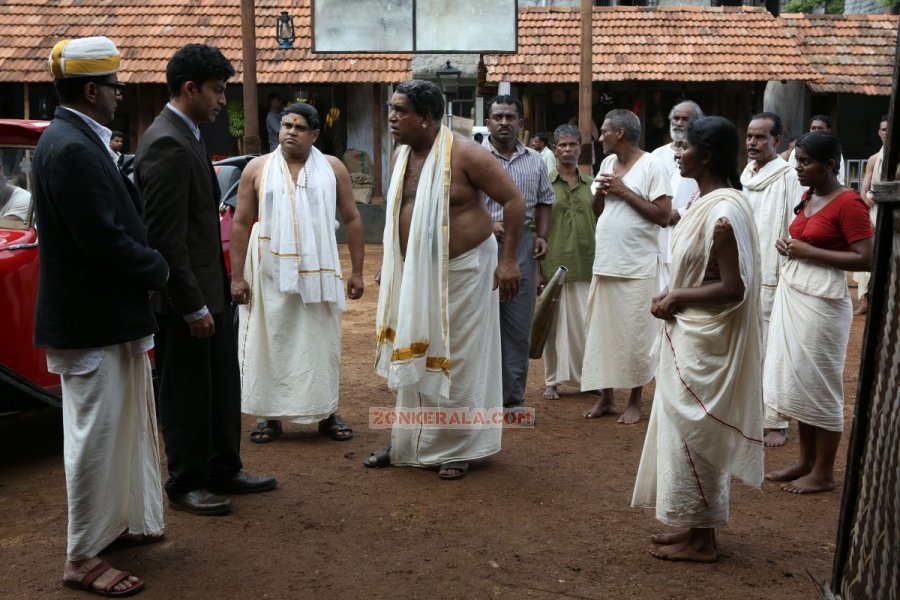
I have a hunch that more than telling the story about a long-forgotten pioneer in Malayalam cinema, director Kamal (not to be confused with actor-director Kamal Haasan) wanted to take his viewers through a journey to the times when films where made on film and projected through film. Though 35mm screenings have remained the norm until a few years back(I'm talking about India), the movie going public were largely ignorant of how a series of 24 still pictures flickered on the silver screen to create movement ever since they were bombarded with several video formats like the VHS, VCD, DVD and now the Blu-Ray. Nostalgic crap, you would say, but it is also evident of the attachment an artist can have with his tools.
This feeling for a fast-dying tradition is evoked throughout the movie, right from the first scene when a child burns an entire reel of film down to the last scene, where JC Daniel's last son, Harris (Prithviraj again) confesses that he had burned the only copy of Vigathakumaran (The Lost Child), the first film made in Kerala, by a Keralite. Several such glimpses abound in the movie, like in the scene where he holds out a strip of film to his wife Janette (Mamta Mohandas) and explains how the illusion of movement is created. Another moment is while he lovingly rewinds a reel of Chaplin's The Kid and briefly dwells on Chaplin's image embedded on each frame.

One of the disappointments I encountered with Paresh Mokashi's Harishchandrachi Factory, which documented the making of the first Indian film Raja Harishchandra, was that despite the better quality in the acting, the filmmaker hardly touched upon this aspect, and worse, treated silent films as an anachronism. Celluloid, on the other hand, dwells on its protagonist JC Daniel's (Prithviraj) initial fascination with the film medium and is more respectful of the early films, as seen when the local townspeople witness a screening of The Kid which is held in high regard by our protagonist. If the film is to be believed, JC Daniel had set his ambitions higher, and unlike the staple mythological films made in the country at the time, wanted to make a "social drama" that could stand on a par with Chaplin's masterpiece.
The first half of the films are laden with a lot of humour, when Mr Daniel begins shooting his film and has to handle actors who have never seen a motion picture camera before. The social context of the times is also an important sub-plot in the film, especially the despicable tradition of caste oppression, which Daniel boldly defies by roping in a lower-caste woman Rosamma (Chandni) for the role of a Nair woman in his film. This will turn out to be the nemesis for Vigathakumaran, the film whose fate turns out to be exactly that of its title.

The film's second half chronicles how Chelangatt Gopalakrishnan (Sreenivasan), the writer, catches up with an aged, impoverished and forgotten Daniel and writes his biography, the only source of reference for anything related to the pioneer, and we follow his struggles as he tries to get the government to give the forgotten pioneer credit as the father of Malayalam Cinema. Though not as interesting as the first half, it still is an interesting watch, thanks to a decent script by its director Kamal.
I would, however, not call the film a masterpiece, especially not when you have Prithviraj, the lead actor, delivering an uninspired performance, which is the same of all his films. But you take it for granted that there are no other actors in the industry young enough and can get the Travancore accent right, besides the fact that you need a familiar face to bring the audience to the theatres. Equally unimpressive is Mamta Mohandas' performance, though she does better in the second half as the aged wife. This handicap of the film is given redemption by a strong supporting cast and by some impressive production design.
Despite its flaws, Celluloid is still a recommended watch since it is, to me, more original than what normally passes for as "new generation" cinema in Kerala and the downplaying of musical numbers as seen in a handful of recent releases is indicative of a sort of recovery in Malayalam cinema, which, for more than a decade, was hell bent on churning out stuff that looked like its counterparts in Tamil and Hindi.
Directed by Orson Welles
Written by Orson Welles and Herman J Manciewicz
Cinematography by Gregg Toland
Edited by Robert Wise
Music by Bernard Herrmann
Starring Orson Welles, Joseph Cotten, Agnes Moorehead, Dorothy Comingore, Everett Sloane, Ruth Warrick
A shot of a wired fence with a No Tresspassing sign on it and a castle in the distance dissolves into another shot that takes us on the other side of the fence- we have defied the warning.
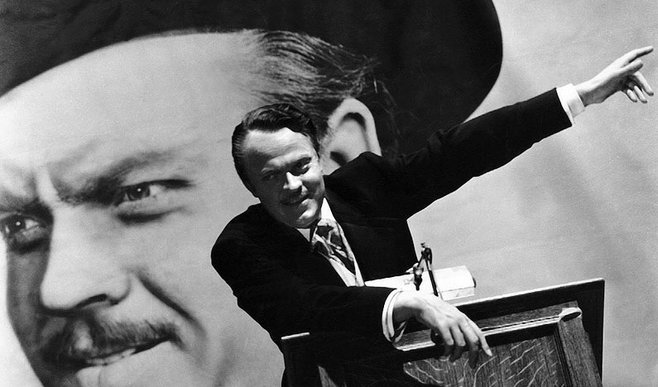
The very opening shot of Orson Welles' debut feature Citizen Kane strangely evokes his own non-conformist nature. He was, in a way, signifying through the very first couple of shots that he was going to break all the rules that hitherto existed in the Hollywood tradition of filmmaking.
The film, as we all now know it, is a character sketch of Charles Foster Kane, the newspaper baron and pioneer of yellow journalism, from the perspective of a newsreel, Kane's guardian Mr Thatcher's manuscript, and testimonies provided by his associates and partners, interviewed by a journalist who wants to know what Rosebud, Kane's dying word, is all about. While neither of them has a clue, the audience finally gets to see at the end of the film what it is all about.
The story of how George Orson Welles, an amateur theatre and radio artist, grabbed a Hollywood project at age 24- a deal which most people could only dream of -is the stuff of legend. Welles had already gained fame and notoriety for staging Shakespeare's Macbeth using a team of Afro-American actors, and for his radio adaptation of HG Wells' War of the Worlds, which drove an entire city wild with panic. His approach to his first movie project was also in the same spirit of rebellion, and that is exactly what makes Citizen Kane such an enduring film.
Another fact about the film that is enshrined in legend is that the film takes several digs at William Randolf Hearst, the real-life press baron still living at the time, who made a marketable commodity out of journalism. Another side of the mogul that was extensively caricatured in the film was his relationship with his mistress, actress Marion Davies, who was portrayed as Susan Alexander, a singer in the film.
While the premise in itself had enough to give it notoriety, Welles looked for more. Another factor that gave Kane its notoriety upon its release and which is one of the reasons the film is celebrated today is its technique. The film made extensive use of fragmentary flashbacks, cunning editing (the abrupt cut from Kane's deathbed to the obituary newsreel; a 10-year-old Kane wishing Thatcher Merry Christmas to Thatcher wishing Happy New Year to a 25-year-old Kane), expressionist lighting, an unconventional soundtrack, deep focus photography and single take coverage of scenes. All this, packed into a two hour movie, seemed too much for the audience of 1941 to take in, and Citizen Kane failed at the box office.
But this notoriety turned into renown in a few years' time, thanks to the critics' championing of the film (Andre Bazin, especially, was bowled over by the film's use of deep space, so was Bosley Crowther of the New York Times), and especially by the interviews delivered by Welles and his DP Gregg Toland. That, and the relative oblivion of non-Hollywood films in the international film scene helped Kane in being reputed as the first film that made use of the effects mentioned above. It also won acclaim as being the first film that showed the ceilings of sets.

But as time has now proved, several of these innovations were already in place in other filmmaking cultures. Post-50s, the proliferation of film festivals and international film culture revealed that Mizoguchi and Ophuls were already pioneers of the long take, Renoir had perfected deep focus photography in The Rules of the Game, and Yasujiro Ozu was showing the ceilings of sets years before Kane was released. Despite these revelations, Welles' film continued to be voted as the greatest film ever made for over 50 years, until Hitchcock's Vertigo toppled it in the Sight and Sound list of 2012.
This surely does not mean that Citizen Kane is not a great film, for it truly is one of the twentieth century's great works of art that demands analysis yet defies it. While the several innovations the film is credited with was already in place in several filmmaking traditions around the world, Welles, as he himself admitted in an interview, had the advantage of total ignorance of their use by other directors and hence, made use of them in his own, original way. Besides, he had the expertise of cinematographer Gregg Toland by his side, to whom he would ever remain indebted.
Directed by Rajeev Ravi
Written by Santosh Echikkanam
Starring Fahadh Fazil, Andrea Jeremiah, Aashiq Abu
The basic premise of Annayum Rasoolum is one of the most cliched, predictable and what was once the staple fare of pan-Indian cinema through the late 80s and 90s: love at first sight, boy pursuing girl until girl agrees to fall back in love, unwilling families on both sides, girl eloping with boy, and the eventual climax. But what makes this film worth the watch is the freshness in treatment.
For one thing, the traditional song-and-dance routine is entirely done away with, the songs merely to highlight the emotional state of either of the characters. The story is set around Fort Kochi , serves as a major backdrop to the events around which the story will turn. A lot of emphasis is placed on characterisation, and each character in the film become quite believable. Dialogues are pared down to a minimum, and melodrama is also downplayed to a great extent. It is the eyes that do most of the talking, especially the eyes of our protagonists. Everything, from infatuation to search, discomfort, anticipation, acceptance, disillusionment and devastation are all communicated with the eyes.
Rajeev's skills as director are also evident in this work, in the way he stages his scenes and especially in his handling of actors. Annayum Rassolum is one of the most well-acted films in Malayalam I have seen in a long while, and every character, right down to the menacing brother of the heroine (another cliche!), are done quite convincingly. Even directors Aashiq Abu, as Rasool's brother and Renjith as their father, have played their parts convincingly.
When a film has so many virtues, one has to ignore the weak storyline. And yet, the film manages to rattle you with its ending in ways few films dealing with the same plot actually can. And have.
Produced and Directed by Jacques Tati
Written by Jacques Tati, Jacques Lagrange and Jean L'Hote
Cinematography Jean Bourgonin
Editing Suzanne Baron
Starring Jacques Tati, Jean Pierre Zola, Adrienne Servantine, Alain Becourt
How do you study a film that is devoid of plot or detailed character analysis and yet is a classic?
Jacques Tati is perhaps the cinematic equivalent of Samuel Beckett, whose plays dispensed with the Aristotelian tradition of storytelling, which laid emphasis on plot and characterisation. Both Beckett and Tati dealt with the increasing isolation of the individual in the modern world.
As one of the major filmmakers during the post-war era, Tati, along with others like Antonioni, Bresson, Bergman and Godard, would be instrumental in changing the way films were read. His third feature film and his first in colour, Mon Oncle is essentially a tour-de-force of set pieces involving Mr. Hulot, Tati's trademark character, and his sister's son Gerard, who lives in an ultra-modern house and spends every evening after school with uncle Hulot. While Gerard and his mother are fond of Hulot, his father, an executive at a factory, is disdainful of him, largely due to his simplistic ways.
Hulot's sister tries every trick possible to get her brother into respectable society, like getting him a job at her husband's plant and finding a girlfriend for him, but they all simply fall flat. Hulot simply does not fit in "society proper"
Several of the film's set pieces revolve around the ultra-modern house Gerard and his parents stay in. It goes without saying that one of the prime concerns of the film is its lampooning of modernity. But that is not all there is to it. Tati also takes several digs at a society that prides itself on status and wealth.
Mon Oncle earns its praise mainly due to the way Tati gets his points across to the viewer. His use of colour to pit the old-fashioned world of Hulot to the modern, sterile world of his sister and her family, is simply extraordinary for its time. The dull greys of the modern settings, with the occasional intrusion of strong colours, is strongly contrasted with the warmer colours of Hulot's old-fashioned world.
Tati's disregard for convention can also be seen in his mise-en-scene. Close-ups and editing within a given scene are generally eschewed, opting to let the scene play out in distant, uninterrupted takes. He compensates for this relative rigidity in camera style by making extensive use of choreography, which makes the images a delight to watch.
Even more demonstrative of Tati's flouting of convention is his use of sound, and the soundtrack of Mon Oncle, as that of all of Tati's work, is one of the most meticulously designed in all of cinema. While there is little dialogue in the film, what dialogue there is is largely reduced to being just another sound effect. And yet the soundtrack adds so much to the spirit of the film that a great deal of the film's humour is lost if you switch off the sound, despite the fact that there is little dialogue in it.
There are several analogies that rise when mention is made about the Hulot character, mostly to the Tramp character of Chaplin. They are similar in that we see the same character in successive films (Unlike Keaton, who had different names in each of his films, but shared the same traits). Both characters are non-conformists who do not give a damn about the world. But while the Tramp is a yearning romantic, Hulot is not and does not care to be. His cool detachment is more like the Keaton type.
Tati's brand of film comedy clearly draws from the work of the great silent comics, and he is perhaps the last film artist to have taken their legacy forward. Sure is a pity that this legacy has not been taken forward.