Wednesday, December 31, 2014

Reflections on IFFK 2014

For all the controversies that marred the Adoor Gopalakrishnan Committee, delegates at this year's edition of the International Film Festival of Kerala were almost unanimous in their appreciation for the package presented this year. This time around, I had a lot more time in my hands, and feasted my eyes on more than a dozen movies, including some featured in the competition. So I do have a lot to write about, though I won't be writing about all of them; just the ones that made the best impression on me.

They are the dogs
Of the films I saw in the competition section, the one that impressed me the most was They are the Dogs, a Moroccan-French co-production written and directed by Hicham Lasri. Set in 2011 during the Arab Spring in Casablanca, the film revolves around a TV news reporter and his crew who stumble upon an old man out of prison after he was arrested in the 1981 Casablanca uprising. Thirty years on, the man has slightly lost his mental balance, can't remember his name (he identifies himself with the number 404), and wants to reunite with his wife and son. The reporter, who smells a good story, follows him along with his crew.

With much humour and irony, They are the Dogs, through the senile old man (played admirably by Hassan Badida), reflects on the harsh political conditions in Morocco, and we see the film as recorded by the TV news camera. The almost cinéma vérité approach makes the camera a participant in the narrative, and the object of people's ire as an unwanted intrusion; even the news reporter and his crew are subject to the same treatment. But the comically exaggerated reactions of people towards the camera brings home the truth that what we are watching is no documentary. By employing the cinema verite aesthetic to craft a work of conscious artifice, director Lasri subverts its very purpose.

Seven-year-old Matias (Sebastian Molinaro) and his pregnant mother Laura (Julieta Diaz) flee his abusive father in search of a safer abode in the Argentinian Refugiado, winner of the best film award. The Diego Lerman-directed drama follows the mother-son duo as they move from women's shelter to hotel and a brothel before finally arriving at Laura's childhood home, where her mother stays. Her husband, Fabian, is never seen in the film, but he remains a constant presence through his relentless phone calls.

Refugiado
Director Lerman presents the story as little Matias sees it, and it is mostly through his point of view that the story develops, giving several sequences a childlike naivete. Especially memorable is the episode where Matias befriends another little girl about his age in the women's shelter until he has to leave with his mother. But there are moments when the film shifts to Laura's point of view, especially when Matias locks himself up in the bathroom demanding that he take all his toys as they prepare to desert their home, with Fabian close on their heels. The film features gripping performances from the lead pair of mother and son, along with impressive cinematography by Wojciech Staron, and the final sequence of the boy running into the woods somehow seemed to remind me of Truffaut's 400 Blows.

Less impressed I was with the Japanese Summer, Kyoto, which won Hiroshi Toda the best direction prize. In it, an aging couple make their living by selling scented bags, until one evening the husband brings home a man he had found lying unconscious outside. The next morning, the stranger, feeling better, expresses his gratitude by offering to deliver the day's consignment of scented bags. But when he fails to turn up with the money after dusk, the couple grow anxious. If the film's theme seemed like a pretentious parable, its stylistics smacked of Ozu to me.

Hill of Freedom
Another film I found remarkable was Hill of Freedom by the South Korean director Hong Sang-soo, a romantic comedy featured in the World Cinema section. Kwon (Seo Young-hwa), a teacher at a language school in Seoul, receives a bunch of letters Mori (Ryo Kase), a Japanese teacher whose proposal she had rejected and who had come over to the capital city to meet her during her absence, and written a string of letters to her. The letters being undated and mixed up after they were dropped by Kwon, give us an account of Mori's stay in Seoul in non-chronological order, in the order in which Kwon reads them, and we come across such characters as Sangwon (Kim Eui-sung), his landlady's nephew, and Youngsun (Moon Sori), who runs a cafe that bears the film's title, and with whom Mori develops a relationship.

Being a cross-culture film, it seems only natural that most of the dialogues are in English. The director uses the opportunity to poke gentle fun at the superficial internationalism of present-day urban youth, which is in large part derived from American popular culture. Especially amusing are the conversations in English, which seldom go beyond fake pleasantries and the most banal of exchanges. While the fragmented narrative and single-take coverage of scenes are innovations that are as old as cinema itself, director Hong-sang Soo's cleverly written script gives the film its originality, backed by a brilliantly deadpan performance from lead actor Ryo Kase, who played the menacing boyfriend in Kiarostami's Like Someone in Love, which I had seen and written about two years back here.

Miklos Jancso
However, my discovery of 2014 was the Hungarian director Miklos Jancso, whose work was presented in a retrospective here. Having only read about the master, who died earlier this year, in film writings, I knew what to expect.

Paying not the slightest obeisance to the rules of narrative cinema, Jancso's films, often dealing with Hungarian history and politics, take the form of highly stylised ballets and are filmed in takes that go on for minutes without a cut, employing complex camera movements. In total, a Jancso feature, which could have a running time of anywhere between 70-90 minutes, may not have more than 30 shots. While I could not read into the elaborately choreographed ballets (given my ignorance of Hungarian history or her politics or ballet dancing), the qualities that struck me were his style. I had known and admired the work of several long-take masters like Renoir, Mizoguchi, and Welles, but Jancso's use of the long take seemed strikingly original.

I managed to catch Silence and Cry (1968) and Red Psalm (1971) in decent, occasionally scratchy, 35mm prints. The former film told the story of a revolutionary who goes into hiding in the country after the failed Hungarian uprising of 1919. While the film was a more straightforward narrative with no ballets or songs, it did feature his long takes. Red Psalm, on the other hand, dealt with a peasant uprising in 1890, featured the very qualities of Jancso's work mentioned above, and won the best direction prize at the 1972 Cannes Film Festival.  While the print of Red Psalm, shot in colour, had faded to pink, Silence and Cry, in black-and-white, were beautiful in the portions without scratches, more beautiful than any digital projection could dream of.

Buster Keaton
The other rewarding experience at this festival was the opportunity to watch Buster Keaton, also in retrospective. Though I had seen the great silent comedian's work on laptop and on TV, nothing really compares to the experience of watching silent comedy on a 25ft screen, in the dimensions they were originally designed to be seen. I couldn't watch The General (1927), arguably his greatest film, which was screened before I could make it there, though I would have given anything (except my job) to watch it on the big screen. But I did manage to catch the marvellous Sherlock Jr. (1924). While the celebrated sequence where Buster, working as movie projectionist, enters the movie screen remains its biggest eye-grabber, the other gags from the film were no less astounding, and was the film greeted with applause that could match that of any film presented this year. Not bad, for a film made nine decades earlier.

Seven Chances (1925), however, was a disappointment, not merely for its unremarkable plot, but more for its blatant racism towards African-Americans, and the gags directed at them seemed to me in poor taste, and especially unfortunate for an artist like Keaton. But this retrospective has had me looking forward to more opportunities to catch silent cinema, especially silent comedy, projected on a 25ft screen.

I ended my brief (but longer than usual) stay at this year's festival with Mohsen Makhmalbaf's President, made in Georgia. The Iranian director-in-exile, much affected by the Arab Spring and other uprisings against dictatorships, resorts to a political parable here, as a dictator of an unnamed country witnesses an revolution that topples his government. Generally referred to as President and addressed as Your Majesty by his grandson, the military also turns against him, forcing him and his grandson try to flee in disguise to the neighbouring country, where the rest of his family are. What begins as a lightly comic take gradually transforms into high-octane drama, as in their attempts to conceal their true identities, the dethroned ruler and his grandson find themselves witnesses to the suffering inflicted by his brutal regime, and the widespread turmoil that revolution has caused.

President
While it is a given that dictatorships are ruthless and uprisings were only to be expected, Makhmalbaf refuses to side with any group. While he lampoons the vanity of the dictator and his family, he is seldom demonised. While the suffering he inflicted on his subjects prior to the revolution is often referred to, Makhmalbaf reminds us of the general state of anarchy and opportunism that accompanies an uprising, and often questions the legitimacy of violent revolution. Towards the end, Makhmalbaf turns his camera away from what would seem like the film's tragic outcome to a shot of the dictator's grandson, as he erupts into a dance for democracy.

While the film risks seeming simplistic in its attempts to be universal, I still find it one of the most compelling films I've seen in a long time. Makhmalbaf narrates his story with such ease without the slightest self-conscious attempt at cinematic bravura, and the transition in tone from the comic to the dramatic so seamless, that you realise you are watching the work of one of the finest directors today.

So that's that for now. See you until my next post.

Sunday, August 31, 2014

Ikiru (Akira Kurosawa - 1952)

Directed by Akira Kurosawa
Written by Akira Kurosawa, Hideo Oguni, Shinobu Hashimoto
Cinematography Asakazu Nakai 
Starring Takashi Shimura


Of the great Japanese directors (or at least those that I am aware of), Akira Kurosawa seems to have been the most preoccupied with moral dilemmas, of the spiritual fragility of humankind. Kurosawa's fixation with the darker side of human nature seemed to cover most of his oeuvre, and these themes percolated in his period pieces as well as dramas set in contemporary backdrops, and of the latter, Ikiru could very well be the finest. 

The film's premise of an aging government official diagnosed with a terminal illness and with hardly a year to live provided Kurosawa enough fodder for a critique of bureaucracy as well as the cynicism of modern society. But most of all, as the title Ikiru (which roughly translates as "to live") indicates, the film also asks what it means to live, which is not the same as merely existing.

When the film's protagonist Kenji Watanabe (Takashi Shimura), after 30 years in government service, realises that he has stomach cancer and has less than a year to live, he is faced with the bare truth that he has accomplished nothing all these years. Deciding to make the most of the time he has, the otherwise miserly Watanabe indulges in the city's nightlife and tries to flirt with a young woman from his office, but he soon tires of it. With his days coming to an end, he seeks truth, or simply put, a sense of purpose. And he very soon finds it during one of his evenings out with the young woman.


'Ikiru' is split neatly into two halves, the first depicting Watanabe's predicament and his search for meaning, and the second a memorial after his death, where his co-workers discuss his "legacy". Kurosawa opens the film by showing us an X-ray of Watanabe's cancer-afflicted tummy, followed by a dissolve into a shot of Watanabe, surrounded, even overwhelmed, by files all around him. Almost immediately, we are shown a group of women making a ruckus with the local municipals for taking so long to cover up stagnating water bodies in their area, giving us a glimpse into the rampant red-tapism in public sector bodies in Japan at the time. It would also prove to be a vital part of the narrative, later on. 

Throughout the remaining portion of the first half, Kurosawa tries to put the viewer on its protagonist's side, imploring us to empathise with the poor man's plight. To make sure that we do, Kurosawa makes use of every possible device in his cinematic arsenal - deep focus photography, montage sequences, wide-angle shots etc.. Especially moving are the montage sequences where he flips through memories of life with his son whose mother died when he was a kid (the son is now indifferent towards his father), the long shot showing Watanabe all alone in the clinic as he waits for the doctor's verdict, a desolate figure, and the close-up where Watanabe, looking straight into the camera, sings in a drunken stupor, "Life is short - fall in love, dear maiden", as his eyes brim with tears. When Watanabe, after finding his purpose, walks out of the restaurant when a birthday celebration is on in the background with the "Happy Birthday" refrain, it is hard to miss the allegory.


It is in the second half that Kurosawa's portrait of contemporary Japanese society becomes especially bleak. As Watanabe's co-workers gather at a memorial held after his death, what begins as a discussion on whether he was aware of his terminal illness soon delves into something less than mud-slinging, as they try to wring credit out of the departed bureaucrat for his parting gift to the world, which was to cover up the open sewer and turn it into a children's park. As they gulp cup after cup of sake, Kurosawa lets us note the irony with which the bureaucrats, who were all too eager to dump the women's request to the other department, are now desperate for the credit once the work has been completed.

But Kurosawa refuses to be cynical about humanity. As the film closes on a shot of the park with children gleefully playing in it, we are reminded, without any words spoken, that Watanabe's efforts, no matter how late in life, did not go in vain, and that the world could do with a few more of his ilk.

Kurosawa's flashy style when it came to telling his stories, which play upon the film's pacing too, are in marked contrast with the more nuanced styles of Ozu and Mizoguchi. One might even be tempted to call his style "brash", as many have, but does that really matter? He spoke from his heart, and was master of his craft, which alone accounts for his triumph as one of the cinema's formidable artists.

Wednesday, May 28, 2014

Close-Up (Abbas Kiarostami-1990)

Written, Directed & Edited by Abbas Kiarostami
Cinematography by Ali Reza Zarrindast


To the casual viewer, Close-Up may not seem to be much besides a crudely shot docu-drama about an impostor impersonating famous filmmaker Mohsen Makhmalbaf and his subsequent arrest and trial (as it seemed to me the first time I saw it at a college screening). Depending on one's level of tolerance - or the lack of it - the film could either put one to sleep, or cause a riot (the screening I mentioned was greeted with boos and catcalls).

But if one took the trouble to sit through the film not once, but twice or thrice, one begins to see just how deeply sophisticated and richly textured the film is. It reveals its beauty at its own pace, like a flower blooming, regardless of whether or not you have the time for it. And the more you watch it, the more you realise that everything in the movie, even its apparent crudity, has been put there by its director Kiarostami for a reason.

The central character in Close-Up is Hossein Sabzian, facing trial for posing as Makhmalbaf to the Ahankhahs, a middle-class household, and even promising to cast them in his next picture, which he intends to shoot at their home.

The heart of the film is the trial, where Sabzian, a divorcee and former employee at a print shop, admits to his guilt. He goes on to speak of his love for the arts when he was a youth, his indebtedness towards Makhmalbaf's films for his portrayal of the suffering of the underdog, his desire to work in films which he had not the means to pursue, and how, when he was mistaken for the famous director by a member of the Ahankhahs, he seized the chance to play a part he had always wanted to.


The picture that emerges is that of a character which may turn out to be one of the most enigmatic in all of cinema, because Hossein Sabzian is not your everyday criminal (What kind of con men would quote Tolstoy during a trial?). As he admits, this is the first time he has ever committed a crime. Like the title character in Monsieur Verdoux, he turns to crime not for personal gain, but to assuage the futility and monotony of his former existence. 

Kiarostami, who until then had been making short and feature length films for children (like the charming Where is the Friend's Home?), was intrigued by the story which he first encountered in a magazine piece. So, the story goes (As Kiarostami says), he obtained permission to film Sabzian's trial, recorded separate interviews with the principal (and a few not important but still relevant) characters in the episode, and even staged a few scenes of the encounter between Sabzian and the Ahankhahs, played by the same people.

Kiarostami also staged a prologue, where a journalist and two policemen are on their way to nab the impostor in a taxi, and a trademark Kiarostami sequence of a lengthy conversation in a cab follows. He finally wrapped up the film with a happy ending by having Makhmalbaf actually meet Sabzian upon his release from prison, and effect a reconciliation with the Ahankhahs.


Just when you thought that was all there is to the film, think again. By re-enacting several major episodes with the same cast and intercutting them in between scenes of the trial, Kiarostami blurs the line between truth and artifice. The occasional peeping microphone, the glaringly visible camera in the side window of a car and the frequent addresses of the interviewees to the director himself may seem like a cinema verite-inspired approach, but in fact in a film that is essentially about deception and camouflage, Kiarostami too seems to have joined the game, constantly deceiving us and forcing us to question the legitimacy of what we take as truth.

The film was revelatory to me in another way. Sabzian, to me, personifies the last vestiges of a civilization in which culture and the arts truly belonged to the people, unlike our present times, where philistinism is the order of the day, and anything that has to do with art is condemned 'elitist' or relegated to museums.

Sunday, January 12, 2014

The Duo (Mani Ratnam- 1997)

Directed by Mani Ratnam
Written by Mani Ratnam, Suhasini
Cinematography Santosh Sivan
Starring Mohanlal, Prakash Raj, Aishwarya Rai


Mani Ratnam called Iruvar- the original title of the film- his best work (so far). As far his other films go, I remember watching only Nayakan, Anjali and Mouna Ragam, and my memory of these films are too distant to make any remark on them, having seen them at a time when I had not yet donned the 'cinephile' mantle. But I would not hesitate to call it one of his best, in spite of its shortcomings.

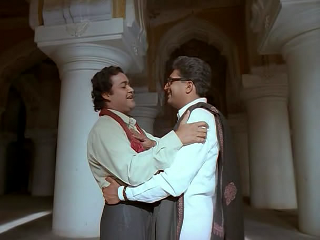
Set in Tamil Nadu in pre-independence India, The Duo charts the lives of the actor Anandan (Mohanlal) and the writer-cum-politician Tamilselvam (Prakash Raj) over a period of four decades. The two meet as ambitious young men who want to make it big in the world. Both become successful in their respective fields, each using the other for boosting mass appeal. But with time they become increasingly distant, giving way to jealousy, which is then transformed into political rivalry when Anandan makes his foray into politics, usurping his once-close friend as Chief Minister of Tamil Nadu. The film then concludes with Anandan's death while in office, and that is when the bond between the two protagonists is eventually reconciled. A major sub-plot of the film involves the private lives of the two friends, and how they shape the development of the protagonists' lives, and subsequently, the narrative.


As is very well known, the film is a slightly fictionalised account of the relationship between the legendary MG Ramachandran ('MGR' as he is popularly known) and DMK chief M Karunanidhi and attempts to examine the eerie relationship between cinema and politics in South India, especially Tamil Nadu. The narrative progresses in episodic fashion as it shifts between the lives of each of the protagonists as they move through each phase of their lives.

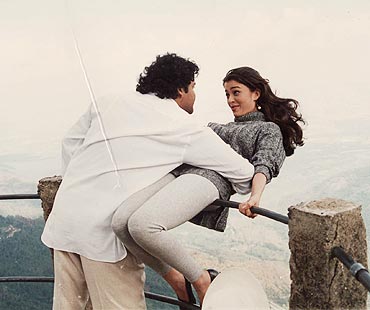
Unfortunately though, what was intended to be a fictional account of two of the most influential lives in the recent history of Tamil Nadu ends up looking something like a fictional biography of the actor Anandan, thanks to six song sequences devoted exclusively to him and a more-than-cursory emphasis on his private life, largely to boost the career of then débutante Aishwarya Rai. As director Ratnam himself admitted in the recent book Conversations with Mani Ratnam, a selection of interviews with critic Baradwaj Rangan, the fact that the film was set largely in tinsel town gave him an excuse to include a number of song sequences that, while being placed in films within the film, also underlines the development of events in the star's personal life, besides drawing the crowds to the cinemas (the film failed there, however).


While the idea is no doubt commendable, six songs put together constitutes significant screen time which could very well have been devoted to the film's core concern, which is all but overshadowed. As a result, the film not only loses its equilibrium but also risks seeming obscure to an outsider, who is likely to question the plausibility of a screen idol suddenly becoming Chief Minister of a state.

And yet, The Duo remains a remarkable movie for a number of reasons- a screenplay that contains several scenes of inspired brilliance, backed by equally inspired lead performances from Mohanlal and Prakash Raj. Mohanlal is especially memorable in this film, delivering probably one of the five best performances of his career. Undoubtedly, the effortless ease and spontaneity with which he is able to articulate otherwise complex states of mind purely through facial and bodily expression instead of dialogue, is some achievement, and something that is sorely missing from his work of the past decade and a half. And when I say that I decided to watch this film solely to watch his performance, I am not exaggerating.

Mani Ratnam's mise-en-scene here also deserves mention. As he revealed in the book, he sought a rapid departure in style, minimising editing and covering sequences in single takes in several instances. And this he seems to have pulled of remarkably; some of the film's sequence shots seem to be straight out of Mizoguchi (I'm not sure, however, if Ratnam was consciously emulating the great master). As always, he makes the best use of available lighting to create visuals which, while being beautiful in their own right, do not become obtrusive.

With all its virtues, a little more attention to the narrative could have made the film a genuine masterpiece. But Mani Ratnam still cannot shake himself of some of the banal conventions of our commercial cinema. He still had to have that scene where the hero waits until the train moves to say goodbye to his beloved wife.

Saturday, December 14, 2013

At the IFFK 2013

My stint at this year's edition of the International Film Festival of Kerala happened to be shorter than last year's, lasting hardly two days. So, I could watch no more than five films, and none of them were in the competition section. Nevertheless I am going to chart down what I thought of the films I saw below, since I don't want to keep my readers waiting for my next entry (what pomposity!).


At least, I was lucky enough to watch ATouch of Sin, one of the year's most acclaimed films by the Chinese Jia Zhang-ke. Far from the rosy portrayal of contemporary China that we are used to hearing in the media, the film is built together out of four separate stories, none of which have separate titles or common characters but a common theme: helpless individuals caught in an increasingly corrupt, materialist and profit-driven world, driven to commit acts of violence, against others and oneself. The pace of the film is, for the large part, contemplative in tempo, with sudden outbursts of violence. Cinematographer Pawel Edelman captures the Chinese landscape in all its serenity, starkly contrasting it with the bleak lives of the characters in the four stories.

Later, I caught up with Claire Denis' 2001 film Trouble Every Day, a multilingual erotic horror film that is centred on two parallel stories, one of an American couple and the other of a French couple, both in Paris. While the American husband is impotent, the French wife's sexual appetite is so insatiable that she engages in sexual encounters with various men, and ends up drinking their very blood. That is all the plot there is to this film.


In what seems to me to be a surreal exploration of the discrepancies between male and female sexuality, Trouble Every Day has more than its fair share of gore, including an extended lovemaking scene that ends in cannibalism.

The Mozambican film Virgin Margarida by Licinio Azevedo charts the experiences of sex workers in guerrilla camps in post-colonial Mozambique in the 1970s, into which a teenager Margarida (Iva Mugalela), mistaken for one them, is forcibly deported. Under the leadership of a woman guerrilla who is single-minded in her devotion to 'cleanse' them of their colonial mindset and make 'new women' out of them, the women, along with Margarida, undergo harsh training sessions with harsh punishments for dissenters. 


While director Azevedo definitely has got his heart in the right place in wanting to show how the revolution could bring about little change in the lives of ordinary citizens of the country and his script mixes irony and drama with relative ease, his performers, however, are unimpressive, chiefly because they fail to make the transition from the comic to the dramatic in their performance. But there is no denying that the film feels quite like one of our day and time, not of a distant period.

Perhaps the best film I got to see at this festival was The Crucified Lovers (1954), one of Kenji Mizoguchi's late masterpieces, in a 35mm print that had good contrast, despite the infrequent scratches. I had never seen Mizoguchi on the big screen, so I did not let go of the opportunity. As always, his indictment of Japanese patriarchy and hypocrisy is at his scathing best in this tale of a samurai's wife who is accused of adultery with one of her manservants, while her husband himself has a sexual interest in her maid.


Like his other masterpieces, The Crucified Lovers is testimony to Mizoguchi's genius as a visual stylist, especially in his trademark long takes, letting the action unfold in distanced views using a moving camera. Watching it on the big screen, I was once again convinced that he is, no doubt, one of the great masters of world cinema.


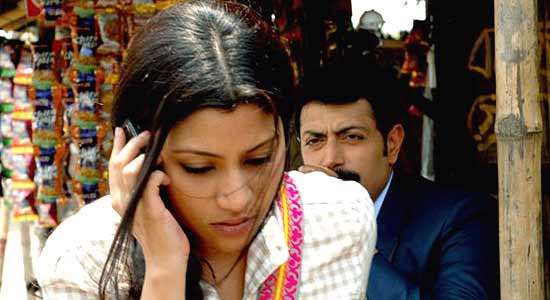
My last film at the festival, Act Zero by Gautam Ghose was the only Indian film I could see on this trip, one that tries to encapsulate in two hours and ten acts the various issues that haunt the country. While the basic premise is that of the CEO of a Multinational trying to invade the lands of tribals by deporting them and mining the area for bauxite, resulting in tensions between the tribal community and the CEO, the director crams in issues like Maoist insurgency, communalism, and throws in a fictional Binayak Sen. The result is an ineptly shot, preachy and didactic film, but one that is nevertheless watchable, thanks largely to the performances of Konkona Sen Sharma and Soumitra Chatterjee.

Thus ended my all-too-brief stay at the festival. There were several other films which I would want to have seen, especially the Jean Renoir retrospective, which screened such titles as Toni and La Bete Humaine, and a special section on German Expressionist cinema, which included such 20s classics as The Cabinet of Dr.Caligari and A Throw of Dice, which is set in India. But there's always another chance.

Monday, October 21, 2013

Le Havre (Aki Kaurismaki- 2011)

Written and directed by Aki Kaurismaki
Cinematography Timo Salminen
Starring Andre Wilms, Kati Outinen, Jean Pere Daroussin, Blondin Miguel and Pierre Etaix


It is not very often that a film labelled "art house" features a happy ending and gets away with it. But (Spoiler Alert!) Aki Kaurismaki attempts exactly that in this comic drama set in the French coastal town from which the film derives its title. And the way the film has been received at major festivals, it could very well seem that the director's courage has paid off.

Centred on an aging shoeshiner Marcel Marx (Andre Wilms) and his efforts to protect and rescue a young African stowaway Idrissa (Blondin Miguel) by dispatching him off to his mother in London, Le Havre could, in lesser hands, turn into an escape thriller in the Hollywood tradition. But Kaurismaki has the entire action played in deadpan, infusing the film with a sense of detachment that only adds to its charm. Yet the film does not fail in winning our empathy for Marcel, Idrissa and Marcel's ailing wife Arletty (Kati Outinen) hospitalised early on in the film with an illness for which the doctor (Pierre Etaix) says there is little hope.


Marcel's efforts at sending Idrissa to London puts him at odds with inspector Monet (Jean Pere Daroussin), whose efforts he must evade to accomplish the task he has set out for. An even greater challenge is raising the money for the journey. But Marcel is determined in his resolve to help the boy.

The thing that is striking about Le Havre is its imagery. In both the photography and the mise-en-scene, Kaurismaki's style is deliberately old-fashioned. Not only is the staging resourcefully simple, with minimal camera movement, but the film, so it seems to me, has completely stayed clear of any digital manipulation, completely keeping its faith in the photo-chemical process. That takes some courage, especially these days.

Watching the film, one is initially confused as to the period in which it is set. While the initial scenes, with Rock 'n Roll music in the background may have you believe that the film is set somewhere in the 70s, a reference to the Al-Qaeda would confirm that the film is set somewhere in the post 9/11 world. Though the film does not make any explicit political statement, it is hard to miss the political undercurrent that runs through it. 

Le Havre, in that sense, is Kaurismaki's way of keeping faith in humanity even in our deeply cynical times, that there is room for compassion even in turbulent times. To condense the review in a nutshell, Le Havre brings together the humanism and politics of Chaplin and the deadpan humour of Keaton.

Saturday, July 27, 2013

Pather Panchali (Satyajit Ray-1955)

Written and Directed by Satyajit Ray
Based on the novel "Pather Panchali" by Bibhutibhushan Banerjee
Cinematography Subrata Mitra
Starring Kanu Banerjee, Karuna Banerjee, Subir Banerjee, Uma Dasgupta and Chunibala Devi


I first saw Pather Panchali at a film society screening, when I was still in college and had little exposure to what cinephiles term "world cinema". My first experience of the film left me confused, to be frank. While the film's beautiful images and music no doubt caught me unawares, I was definitely in the dark as to what the film was coming to say.

I definitely understood that the film was centered on a poor Brahmin family living under grinding poverty in rural Bengal, but all I could see was a series of incidents centered around them, with hardly a plot, and it moved at an excruciatingly slow pace. Where lay the greatness of Pather Panchali? Does it lie hidden in some obscure symbolism, or is the film and its adherents merely being pretentious?


Over the years since then, I happened to see the film close to 10 times in its entirety, and went through every possible literature on the film that I could lay my hands on. Slowly, the film grew on me and I began to realise that the film had no hidden meaning, that everything the director wanted to convey is all there for you to see and hear. Even the novel on which the film is based- and which I haven't read -seemed to contend itself simply with acquainting the reader with the rhythm of life in rural India, it is said.

Soon, I learnt that a story need not always have a plot as in conventional dramaturgy, that it could take the form of poetry as well, by emphasising mood, atmosphere and character psychology instead of plot points. Taken that into view, Pather Panchali does qualify as a masterful piece of filmmaking.

If I failed to "get" the film, as many members of the audience felt during that first screening, it had to do with conventional notions of what comprised "good" or "meaningful" cinema; one of the prerequisites was that you had to have a plot-driven storyline, preferably one with a "message", some hard hitting dialogues, and a style intent on realism. Barring the last of the criteria, Pather Panchali meets none of these.


While the film has often been brushed aside as dry staple for intellectuals to feed on, Pather Panchali actually is a film that needs to be savoured with both the head and heart, only that you needed a heart of a different kind. While you used your brain to admire the way Ray has transformed words on page to an audio-visual experience onscreen, you needed a heart to take delight in such sequences as the one in which young Durga and Apu follow a sweetmeat seller, their astonishment at catching their first glimpse of a moving train, the way villagers react to a band's rendition of Tipperary, and the moments depicting the onset of the monsoon.

While Satyajit Ray's debut feature enjoyed tremendous critical and commercial success around the world, playing in over 20 festivals, it was not without its share of detractors, many of whose claims seem downright ludicrous. While the film received a lot of flak back home (with former Indian actress and Member of Parliament Nargis Dutt leading the tirade) for not showing India as a prosperous country rife with beautiful men and women singing and dancing their way through life, the western world was fairly appalled with its depiction of poverty, and a leading critic for the New York Times lampooned the film's loose structure in his review, saying the film would hardly have passed for a "rough cut" in Hollywood.


Ray, however, was humble enough to acknowledge the last of these claims, for the opening scenes of Pather Panchali are not very promising. Since every member of the crew were amateurs, the film, shot in sequence, bore the marks of a novice in its opening sequences. You felt instinctively that the camera positions were inadequate in some shots, that there was no clear spatial orientation, and cuts were often made at the wrong moments. But as the film progressed, you could clearly sense that this the work of an artist who has a grasp on the aesthetics of the film medium.

While Pather Panchali is by no means Ray's best work, it is definitely the film for which he is most remembered, for the impact it created in international film circles and for the fact that it heralded the arrival of a great master in the scene, the availability of whose films are increasingly becoming unavailable in the country of his birth except in badly damaged prints and DVD transfers.

Thursday, July 11, 2013

Grand Illusion (Jean Renoir-1937)

Directed by Jean Renoir
Written by Jean Renoir and Charles Spaak
Starring Jean Gabin, Marcel Dalio, Pierre Fresnay and Erich von Stroheim


With Grand Illusion (La Grande Illusion in French), the international film scene had taken notice of a hitherto unknown film-making talent- Jean Renoir, son of the famous impressionist painter Pierre-August Renoir. Renoir had been making silent movies from the 1920s and tasted success in the early 30s. With Grand Illusion, he became an international celebrity and the film was a popular success worldwide. Released in 1937, two years before the outbreak of WWII, the film's anti-war stance made it all the more significant.

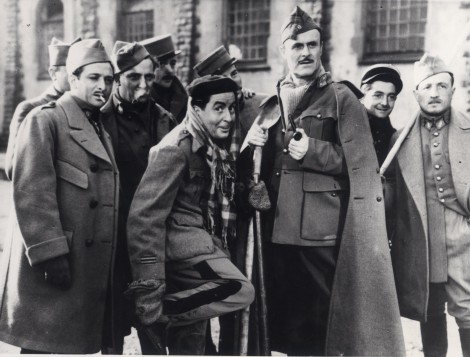
But Grand Illusion is not set in the trenches. The film begins with the French Lieutenant Marechal (Jean Gabin) who, along with Captain de Boeldieu (Pierre Fresnay) are captured by the German forces in an air raid during World War One and shuttled between prisoner-of-war camps in between their efforts to escape. In between this cat-and-mouse game, we come across a range of characters like the Jewish merchant Rosenthal (Marcel Dalio) and the German aristocrat Rauffenstein (Erich von Stroheim), bonds are formed across religious and national borders, and hope is revived in the human spirit.


While the term "war film" generally brings to mind a film with loads of violence, action-packed sequences and a somber ambience, Renoir's war film replaces them with warm humour and compassion, that most essential of human qualities.

Two decades before Grand Illusion, Chaplin's Shoulder Arms (1918) dealt with life in the trenches during WWI, where he discarded his usual sentimental approach to present us with a darkly comic view of the war. But Renoir, having been in the war himself, knew all too well that humanity could exist even in the direst of situations, even across hostile countries, races and religions. This is exemplified in the close friendship that develops between Boeldieu and Rauffenstein, Marechal and Rosenthal, and in the way the escaped prisoners are tended to by a German widow.

Accustomed as we are to reports of prisoners undergoing brutal torture in war camps, the treatment of prisoners-of-war in Grand Illusion does strike us as something new. Not only are they treated more like human beings, you also get to see soldiers having a nice time off the battlefield. Whether this was a luxury offered only the "whites", I'm not sure of.

All that aside, Grand Illusion is one of those films that has everything going for it; a well-knit script with deft characterisation, a magnificent ensemble cast, beautiful background score and Jean Renoir, what more could you ask for?


One of the aspects of the film that remains striking today but was overlooked at the time is Renoir's mise-en-scene. In the first decade of the sound film, when cameras equipped for sync-sound recording were fairly bulky, and without the luxury of shooting in studios, Renoir manages to accomplish complex camera movements which, with their fluidity, remain baffling. But at a time when Soviet montage was hailed as the pinnacle of the art of cinema, the long takes of Renoir, Mizoguchi and Ophuls was underestimated. It was not until Citizen Kane and Andre Bazin's ruminations that the long take came into vogue.

I've seen very few of Renoir's work, but of the ones I've seen, Grand Illusion takes him closest to his idol Chaplin, in its seamless interweaving of humour and pathos, and in the faith it retains in the human spirit.

Friday, June 7, 2013

Modern Times (Charles Chaplin- 1936)

Written and Directed by Charles Chaplin
Music by Charles Chaplin
Cinematography Roland Totheroh
Starring Charles Chaplin and Paulette Goddard


Charlie Chaplin's depression-era masterpiece Modern Times was to represent a significant change in the icon's body of work from this point on. Not only was it his last silent picture (not entirely silent, though, for reasons which we will come to later) and the last vehicle for his character of the Tramp (though a variation of the character could be seen in The Great Dictator), but every subsequent film of his- with the possible exception of Limelight -would have overt political backdrops.


With his overnight rise to international stardom in the late 1910s and subsequent entry into artistic and political circles, Chaplin began to become increasingly politically aware, and it was inevitable that his "political awakening" would be reflected in his work. His interest in world events led the actor-filmmaker to seek meetings with Mahatma Gandhi and Winston Churchill among many others. Gandhi and his views on industrialisation especially seemed to have made a strong impression on him. But it was not simply the perils of industrialised labour that the film would come to address. The devastation caused by the Great Depression of the 30s, which he witnessed on his trip and back in America, would also find their way into the film. 

Despite its grim premise, Modern Times is actually a light-hearted take on the social realities of the time. While general reviews of the time could see nothing beyond the humour, other critics were miffed with the film's refusal to talk when the world was held in sway by talking pictures, its eschewing of plot, and its simple visual style, which seemed dated to many. More highbrow critics disdained its political ambiguity. 

There is no doubt that the film does veer in tone- the futuristic vision in the initial factory sequences giving way to a more contemporary milieu in the rest of the film, Modern Times is rather uneven in tone. But the brilliance of these sequences more than compensates for this minor flaw.


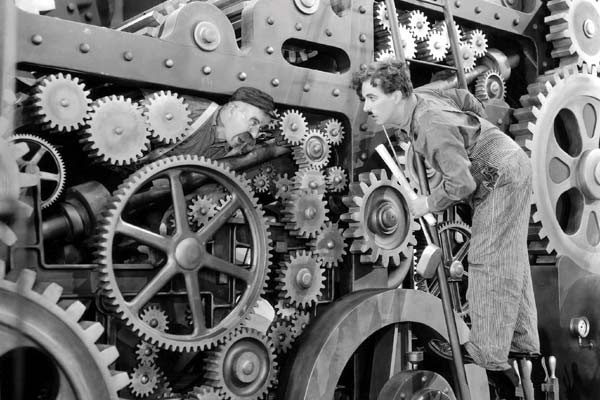
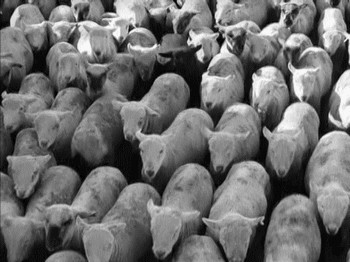
The opening montage- A shot of a herd of sheep dissolving into one of factory workers and a shot of a large factory, is very evident of Chaplin's political leanings. What follows is a series of sketches that begin with the Tramp tightening nuts in a factory that manufactures God-knows-what, until he himself goes nuts over the increasing demands thrust upon him and other workers. Joined by a gamine (Paulette Goddard, his third wife), they fight it out against a world that is becoming increasingly mechanised and profit-driven, to assert their individuality. While they find little success, they are determined to keep fighting.

As with most of Chaplin's work, the things that stick to your mind are the set-pieces- the Tramp being used as guinea pig on a feeding machine that feeds the workers while at work so that the lunch hour could be eliminated, the home that the Tramp and Gamine dream up for themselves, the ballet on roller skates, the Tramp's routines as waiter and so on. While most of the gags aren't fresh in themselves (He does refine some of his old routines from the shorts made for Mutual two decades earlier), he improves upon them, incorporating his own physical dexterity and improved sense of timing, that they blend seamlessly into the narrative.

The characterisation in Modern Times is worth a mention. Apart from the tramp and the gamine, very few characters have any significant screen time. Even the credits mention only two characters, that of the Tramp and the Gamine, the others simply mentioned as supporting players. Their significance is reduced to that of any other prop, simply entering and leaving after their role in the story is finished. Could this be a hint that the world is increasingly peopled by automatons?


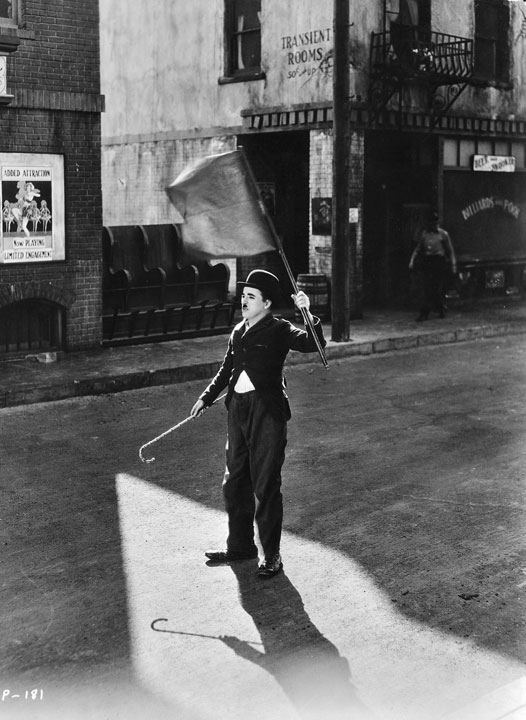
While the opening montage was enough to brand Chaplin as a leftist in an America that treats any leftwing tendency with utmost derision, another sequence that makes a more explicit reference to communist paranoia in the States would forever brand him as a Red in the eyes of Americans. This, perhaps one of the most brilliantly executed set pieces in the film, shows Charlie picking up a red flag dropped from a truck and walking towards it, only to be nabbed by the police who suspect him to be a communist leader. Using no words, and in no more than five shots, Chaplin succeeds in driving home the message. Watching this sequence, one wonders what the pundits who brushed aside Chaplin as "uncinematic", were actually thinking of.

Another remarkable facet of the film is its sophisticated use of sound. True, Chaplin was averse to talk, but he was not averse to the possibilities that sound offered the filmmaker. In his previous release, City Lights, he took the plunge into the sound film by composing a score and adding a few sound effects. But he took his experiments even further here. The only "sounds" you hear in Modern Times are the sounds of machines, of objects. The human voice is otherwise silenced, heard only through a machine like a television screen, radio, or a record. The only person who finds his voice in the film is the Tramp, who breaks into song towards the end, but which is of no particular language, for he is bereft of linguistic barriers. One particular sequence, involving the Tramp and a woman having a cup of tea, is particularly notable, anticipating the work of Jacques Tati.

Modern Times would find more acceptance in the post-WW2 era, and its influence could be seen in works like George Orwell's 1984, with its Big Brother and telescreen clearly reminding us of Chaplin's film. While the film could be considered Chaplin's most formally inventive work, it endures because of the way it resonates with our own times.


Tuesday, May 14, 2013

Bicycle Thieves (Vittorio De Sica-1948)

Directed by Vittorio De Sica
Written By Cesare Zavattini
Cinematography Carlo Montuori
Edited by Eraldo Da Roma
Music by Alessandro Ciccognini
Starring Lamberto Maggiorani and Enzo Staiola


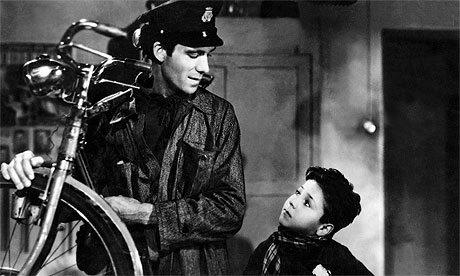
Bicycle Thieves has become so iconic a film that it its reputation soars far higher than any other film made during what generally is called the "Italian Neo-realist" film movement. The neo-realist movement, which lasted roughly from the mid 40s to the early 50s, was a direct response to the devastation caused by World War II in Italy. The movement, which roughly began with Rossellini's Rome, Open City, is generally considered to have reached its artistic zenith with De Sica's 1948 masterpiece.

While umpteen films were made under the tag "neo-realist", only a handful of films have the worldwide acclaim as of now, and of the few that have, De Sica's film remains the most cherished by audiences. One could attribute this to the film's universality. While Rossellini's war trilogy was essentially Euro-centric, Bicycle Thieves, with its searingly simple premise of a man in search of his lost bicycle, made for a theme which anyone anywhere could relate to.

Like most art movements, what made neo-realism a landmark movement in the history of cinema was the distinctive aesthetic it introduced. No longer able to afford shooting within the confines of a studio or with bankable stars, filmmakers had to take their cameras out into the streets, filming with whatever light was available, and by using non-professional actors without make-up. As a result, cinema finally seemed to be shorn of all artifice, and viewers were confronted with bare reality presented to them, without the interference of any manipulation by the studio system.

There were films before the emergence of neo-realism that challenged conventional methods of filmmaking, like the Expressionist cinema of 1920s Germany, the Impressionist cinema in France of around the same period, and the Surrealist movement, but they occasionally used professional actors and studios. Films that veer close to the neo-realist aesthetic of that period would be Flaherty's Nanook of the North, which was shot on location without using professional actors, and Renoir's Toni in the 30s, which would similarly make use of non-actors. But these were individual efforts, and it hadn't yet been proved to the world that an entire cinema industry could make films that way. That would happen only after 1945. Films like Rossellini's War Trilogy and Bicycle Thieves proved that you could make a great film with only a camera and an inquisitive mind.


Yet it would be unfair to credit Bicycle Thieves as the product of one mind. For one, its plot was based loosely on a novella of the same name by Luigi Bartolini, which was turned into a screenplay by Cesare Zavattini, who wrote a great number of films during that period. Later, he would often fume at the fact that credit for the film's greatness went entirely to De Sica, and went so far as to claim that 90 percent of the film was his own creation. While you could credit the writer with his brilliant social observation in the film, since Zavattini himself claimed that he no involvement in the production, you could not overlook De Sica's contribution to the final work, especially in his mise-en-scene and the way he has evoked brilliant performances from a largely unknown cast of non-professional actors.

In its spare use of camera movements, montage and largely medium to long-shot framing, Bicycle Thieves has a stylistic austerity that is reminiscent of a Chaplin film. Even in its worldview, that of a dog-eat-dog world, it is not unlike the themes that pervade Chaplin's work. But it avoids the poetry, gracefulness, and the optimism of the Tramp, to present a more harsher, more fatalistic view of the world.

Upon release and international acclaim, Bicycle Thieves influenced several filmmaking countries of the time, notably in India, which had just emerged from colonial rule. The immediate influence of the film could be seen in films like Bimal Roy's Do Bigha Zamin and Raj Kapoor's Boot Polish, while a hitherto unknown Satyajit Ray borrowed the neo-realist aesthetic to scale poetic heights in his debut feature Pather Panchali.

Wednesday, April 24, 2013

A Hundred Years of Indian Cinema...Or Is It?


Come May 3, 2013 and India's film industry will be celebrating the hundredth year of its birth, for it was on this day exactly a hundred years ago that Raja Harishchandra, supposedly the first Indian film made by the first Indian filmmaker Dadasaheb Phalke, hit theatre screens. In a country known for its lackluster approach to film preservation (bar the efforts of PK Nair, founder of the National Film Archive of India, on whom a documentary, Celluloid Man was recently made, which I have written about here), the fact that we have got the date on which the film was released right is indeed remarkable. But is Raja Harishchandra really India's first film?


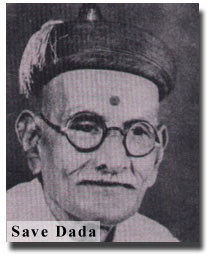
A little more probing would reveal that there have been films made in the country before Phalke's feature debut. Shortly after the Lumiere brothers screened their "actualities" in Bombay (As Mumbai was officially called then) in the late 1890s, a certain Harishchandra Sakharam Bhatwadekar, or Save Dada, a portrait photographer, made a series of factual films a la the Lumiere Brothers in India, the first of which was a wrestling match between two  well known wrestlers of the time, in 1899. He even filmed perhaps India's first newsreel, the arrival of RP Paranjpe, a successful mathematician, from Cambridge in 1901.

In fact, the non-fiction cinema seemed to have been active in India well before Phalke made his entry. By the first decade of the 20th century, cinemas were already established in major cities of the country like Calcutta, Madras and Bombay (though it could be assumed that these theatres screened largely foreign films, like those of George Melies and Edwin Porter). Very soon, Bhatwadekar was joined by other names like Narayan G Devare, the Patnakar brothers and Hiralal Sen, who made factual films that documented day-to-day life in India. A company dedicated to filming newsreels, the Calcutta Film Gazette, was also started during this period.

Despite these facts, the credit for making the first Indian film has always gone to Dundiraj Govind Phalke, partly because none of the films before Raja Harishchandra have survived and also because of the fact that the documentary, or non-fiction film has never been taken seriously in India. But such a claim would be tantamount to assuming that the father of film would be George Melies and not the Lumiere Brothers or Edison.

What makes this celebration even more interesting is the fact that most histories of Indian cinema do recognise the earlier pioneers but since Harishchandra was the first full length motion picture made entirely by an Indian crew, at a full six reels (of which only two have survived) the film and its maker have been accorded first Indian film and first Indian filmmaker respectively. Nowhere do you find a voice that challenges this assumption.


Well, yes, there has been a challenge to this assumption, but of a wholly different kind. The argument that generally goes around is that it is not with Phalke's Harishchandra, but with Satyajit Ray's Pather Panchali that Indian cinema really begins. Mrinal Sen has been the most vocal about this stance. Though there is no doubting the greatness of Pather Panchali  and the fact that it paved the path for a more personal cinema in India, such a claim only amounts to elitism. Yet it could generally be accepted that few filmmakers in India before Ray approached cinema in a wholly original way without the trappings of the theatre or literature. But it does not call for overlooking the achievements of the earlier filmmakers.

So will this piece initiate any debates on the real beginnings of Indian cinema? Very unlikely. Meanwhile, the celebration of our cinema's hundredth anniversary will be celebrated with full pomp and the glorious "achievements" of mostly Bollywood cinema will be glorified as part of the celebrations.